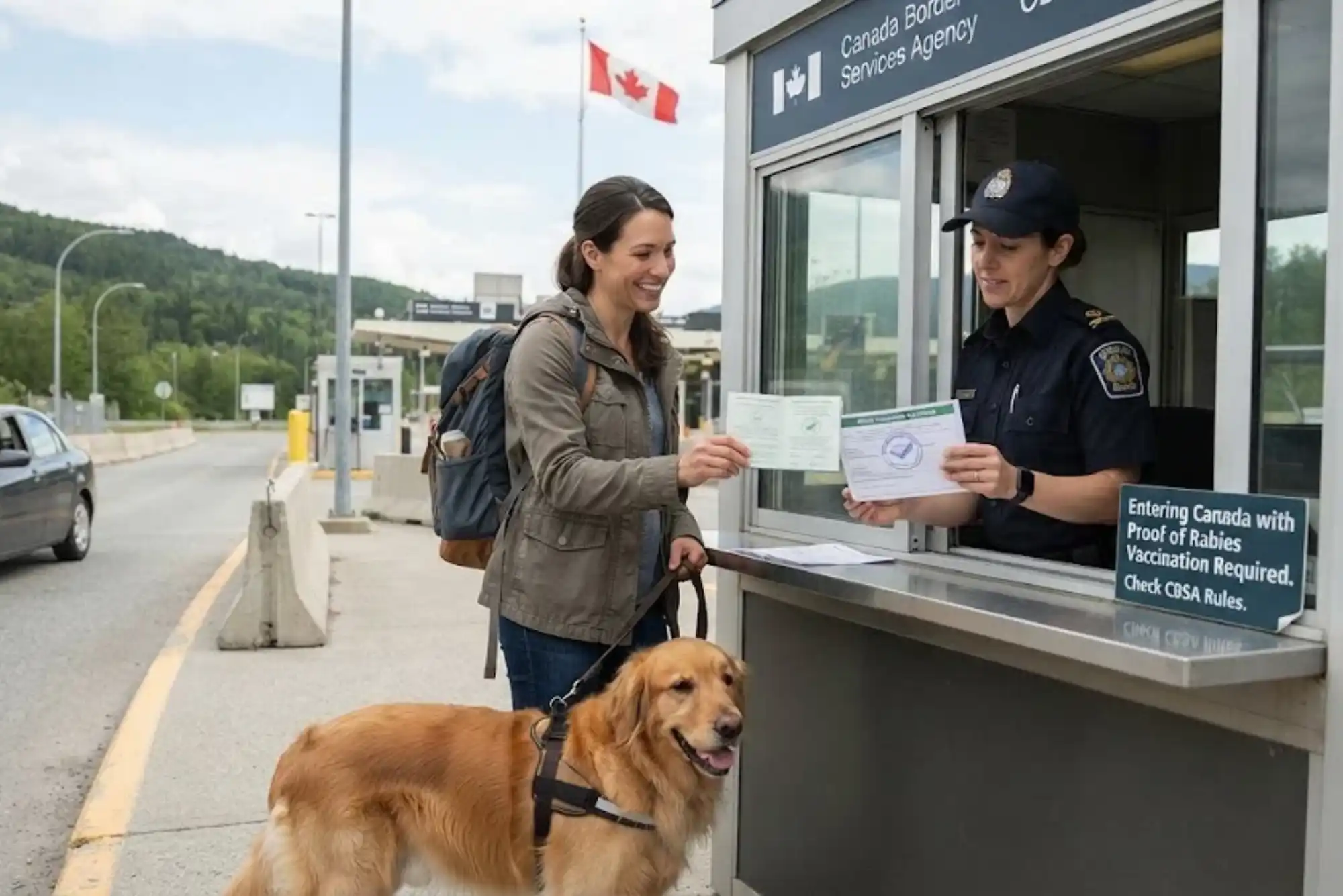
Traveling to Canada with Dogs: Proof of Rabies and Border Crossing Rules
Traveling to Canada with a dog requires more preparation than simply booking a ticket and bringing your pet along. Whether you are moving permanently, taking a vacation, visiting family, or returning to Canada with your dog, you need to understand the country’s animal-entry requirements before reaching the border. One of the most important parts of the process is proof of rabies vaccination or another form of acceptable rabies documentation.
Canada has established animal import requirements to help protect people and animals from diseases, including rabies. The Canadian Food Inspection Agency (CFIA) states that travelers are responsible for making sure their pets meet the requirements that apply to their specific situation. Depending on the dog’s age, country of origin, purpose of importation, and whether the dog is accompanied by its owner, different requirements may apply.
For anyone preparing for a cross-border trip, understanding these rules early can make the journey much easier. A missing certificate, an unclear vaccination record, or a document that does not identify the dog properly can create complications at the border. This guide explains the major rabies requirements, documents to prepare, border procedures, and practical considerations for traveling to Canada with a dog.
Understanding Canada’s Dog Import Rules
Canada regulates the entry of dogs primarily through animal-health rules. The requirements are designed to reduce the risk of introducing diseases and to protect animal and public health.
The CFIA explains that requirements can differ depending on several factors. These include where the dog is traveling from, the dog’s age, the purpose of the import, and whether the dog is traveling with its owner. Because of these differences, there is no single document package that applies to every dog entering Canada.
This is particularly important for international travelers. A dog coming from a country recognized as rabies-free can have different documentation options from a dog coming from a country considered high-risk for canine rabies. The Canadian government maintains specific lists and import policies, and those classifications can change.


The safest approach is therefore to determine the dog’s country classification and age first and then check the official requirements that apply to that situation.
Why Proof of Rabies Vaccination Matters
Rabies is a serious viral disease that can affect mammals and can be transmitted to humans. Canada has animal-health measures intended to reduce the risk of introducing certain forms of rabies through imported animals.
For dogs entering Canada, a valid rabies vaccination certificate can be one of the principal documents demonstrating that the animal meets the country’s entry requirements. For dogs from countries that are not designated as rabies-free, CFIA’s current reference document specifies acceptable rabies documentation for many circumstances, including a valid rabies vaccination certificate issued in English or French by a licensed veterinarian in the country of origin.
The certificate needs to clearly identify the dog and show that it is currently vaccinated against rabies. This means that a simple statement saying that a dog has received vaccinations may not be enough if it does not contain the necessary identifying and vaccination information.
Pet owners should therefore ask their veterinarian for complete documentation rather than relying only on a general medical record.
What Should a Rabies Certificate Contain?
The exact documentation requirements depend on the circumstances, but identification is an important part of the process. The certificate should allow officials to establish that the document belongs to the dog being presented at the border.
A useful rabies vaccination record generally includes information such as the dog’s identification details, vaccination date, vaccine information, and the veterinarian’s professional information. The CFIA specifically requires a valid rabies vaccination certificate for applicable cases and says it must be issued in English or French by a licensed veterinarian from the country of origin.
Before leaving for Canada, compare the information on the certificate with your dog’s other records. The dog’s name, identifying details, vaccination information, and other relevant records should be consistent.
If your veterinarian normally provides documentation in another language, ask in advance whether an English or French certificate meeting Canada’s requirements can be provided.
Dogs Coming From Countries That Are Not Rabies-Free
Country of origin is one of the most important factors in determining the documentation needed for a dog entering Canada.
Canada maintains a list of countries recognized as rabies-free for domestic cats and dogs. Countries that are not on the rabies-free list may have different documentation requirements.
For dogs eight months of age or older arriving from countries that are not designated as rabies-free, CFIA’s reference document provides for entry with a valid rabies vaccination certificate issued by a licensed veterinarian in the country of origin. Another possible route in applicable circumstances is a Rabies Neutralising Antibody Titre Test, commonly called an RNATT, meeting the required threshold and timing conditions.
This distinction is especially important for travelers coming from countries that Canada currently identifies as high-risk for dog rabies.
Dogs From High-Risk Countries
The CFIA maintains a specific list of countries and political units considered high-risk for canine-variant rabies. The list is reviewed periodically, so travelers should check the current version before making arrangements.
Travelers should also distinguish between rules for personal pet dogs and rules for commercial dog imports. Canada has restrictions affecting certain commercial dogs from countries at high risk for dog rabies. Those commercial rules are not automatically the same as the requirements for an owner traveling with their personal pet.
Because of this distinction, travelers should identify the purpose of the dog’s entry before preparing their paperwork. A family pet accompanying its owner may fall under a different set of provisions than a dog being imported for sale, adoption, breeding, or another commercial purpose.
Rabies Antibody Testing and the RNATT Option
In some circumstances, a Rabies Neutralising Antibody Titre Test may be accepted as an alternative form of documentation. The test measures antibodies against rabies and must meet specific requirements regarding the result, timing, and identification of the animal.
For dogs eight months or older from countries that are not designated as rabies-free, the CFIA reference document describes an RNATT result of at least 0.5 IU/ml, with the sample taken at least three to four weeks after a previous rabies vaccination in the applicable circumstances. The animal must be properly identified on the laboratory report, and the report must accompany the animal.
Because laboratory testing involves timing, it should not be treated as a last-minute travel document. If your situation requires an antibody test, discuss the schedule with your veterinarian well before your planned departure.
The test also does not mean that travelers should ignore vaccination requirements. The documentation must satisfy the particular Canadian import provisions that apply to the dog.
Rules for Puppies and Young Dogs
A dog’s age can significantly affect the requirements.
Canada’s current reference document states that dogs less than three months old do not require rabies vaccination or certification of origin from a rabies-free country in the circumstances described there. However, the rules become more detailed as dogs get older, and different provisions apply depending on whether the dog is accompanied, the country of origin, and the purpose of importation.
For dogs under eight months, travelers should be especially careful about distinguishing ordinary personal travel from commercial importation. Canada has additional requirements for certain commercial dogs under eight months old, including requirements related to vaccination, age, identification, health documentation, and other conditions.
If you are traveling with a puppy, do not assume that the rules applying to an adult dog automatically apply to the puppy. Confirm the exact requirements before booking transportation.
What Documents Should You Carry?
Good preparation means keeping all relevant documents together and easily accessible during the journey.
The rabies vaccination certificate should be one of the primary documents in your travel folder. Depending on the circumstances, you may also need additional veterinary documentation, test results, permits, or certificates.
CFIA advises travelers to contact their veterinarian as soon as travel plans are known because some requirements may need to be completed at specific times. Depending on the destination and circumstances, preparation may involve health certificates, vaccinations, testing, or other veterinary procedures.
For a smooth border experience, keep original documents together with secure digital copies. Digital copies can be useful if a paper document is lost, although travelers should not assume that a digital image will replace an original document when an official certificate is required.
It is also helpful to keep your dog’s regular veterinary records, identification information, microchip information where applicable, and medication details available during travel.
Preparing Your Dog Before the Journey
Travel preparation should begin well before the day of departure. Veterinary appointments, vaccinations, tests, certificates, transportation arrangements, and border documentation can all require advance planning.
If you are moving with your dog, Moving with Cats provides additional general pet-moving information that may help you think through the relocation process. However, the specific Canadian dog-entry requirements must always be checked separately.
Your veterinarian can help review your dog’s vaccination status and determine whether any required documentation needs to be updated. The CFIA recommends involving a veterinarian in the pet travel process because some requirements must be completed within specific timeframes.
Do not wait until the day before departure to discover that a document is missing or that a required vaccination or test needs additional time.
Crossing the Canadian Border With Your Dog
When you arrive in Canada, you are required to declare animals you are bringing into the country. CFIA states that travelers are legally required to declare plant, animal, and food items they bring into Canada.
Keep your dog-related paperwork accessible rather than packed deep inside luggage. Border officials may need to see the documentation supporting the dog’s entry.
The inspection process can vary depending on the circumstances. Some animals may require additional inspection, and import requirements can depend on the animal and the country of origin.
The most important thing is to answer border officials accurately and provide the requested documentation. Trying to conceal an animal or failing to declare it can create serious complications.
What Happens If Documentation Is Missing?
A traveler should never assume that an incomplete vaccination record will automatically be accepted.
CFIA explains that if a dog arrives at the border and does not meet Canada’s import requirements, the situation will be reviewed and a decision will be made regarding the dog’s eligibility to enter. Depending on the circumstances, the dog may be ordered removed from Canada, and fines or legal action may result.
This is why preparation matters. It is much easier to resolve a documentation problem before departure than after arriving at an international border.
If you discover an issue before traveling, contact the appropriate Canadian authority and your veterinarian to determine what steps are necessary.
Traveling by Air With a Dog
Flying to Canada can be convenient for long-distance travel, but it requires additional planning.
Airlines have their own rules for transporting dogs. These can include restrictions based on the dog’s size, carrier dimensions, destination, season, breed-related policies, and whether the dog travels in the cabin or through another approved transportation arrangement.
Airline policies are separate from Canadian government entry requirements. Meeting CFIA requirements does not automatically mean that an airline will accept the dog for transportation.
Before purchasing a ticket, check the airline’s current pet policy and confirm that your dog meets its requirements. You should also verify whether the airline needs veterinary documents beyond those required by Canadian authorities.
For international flights, allow extra time at the airport because pet check-in can involve additional documentation and procedures.
Traveling by Car Across the Canadian Border
Driving into Canada with a dog can provide more control over the journey, especially for families who are already traveling by road.
However, crossing by car does not remove Canada’s import requirements. A dog entering Canada by land still needs to satisfy the applicable animal-entry rules.
Keep the dog’s documents in the vehicle where they can be reached quickly. Avoid placing important certificates in luggage stored in a trailer or inaccessible compartment.
If you are driving through multiple countries before reaching Canada, remember that every country on your route can have its own animal-entry rules. A document that satisfies Canada’s requirements may not satisfy another country’s requirements.
Planning the entire route is therefore just as important as preparing for the Canadian border.
International Pet Travel Requires More Than One Check
International pet travel can involve several layers of requirements. The country you are leaving, countries you pass through, transportation provider, and Canada itself may all have separate rules.
Travelers can also use TripDomino for general pet-travel planning and related travel information. However, official Canadian government requirements should always be treated as the authoritative source for entry rules.
This is especially important if your journey includes a connection or transit through another country. A pet that is legally allowed to enter Canada may still need additional documents to transit through another jurisdiction.
Microchips and Identification
Identification is another important part of responsible international pet travel.
A dog’s veterinary documents need to clearly identify the animal when identification is required by the applicable rules. Some import categories have specific identification requirements, while ordinary personal-pet situations can differ.
For that reason, travelers should discuss permanent identification with their veterinarian and verify whether their particular import category has a specific microchip requirement.
Even when a particular identification method is not mandatory for your exact situation, reliable identification can make it easier to connect your dog with its veterinary records if something goes wrong during travel.
Keep Your Dog Comfortable During Travel
Legal paperwork is only one part of successful international pet travel. Your dog’s comfort and safety should also be considered.
Long journeys can be stressful for animals, particularly when they involve unfamiliar surroundings, airports, vehicles, waiting areas, and changes in routine.
Before traveling, discuss the journey with your veterinarian. CFIA notes that travel can have a significant impact on a dog’s health and recommends talking with a veterinarian about the travel process.
Your veterinarian can help you understand whether your dog has any individual health considerations that could affect travel. They can also advise you about feeding, hydration, rest, and other appropriate preparations.
Avoid making last-minute changes to your dog’s routine unless they are recommended by a qualified professional.
Common Documentation Mistakes
Many travel problems happen because people assume that having a vaccination is the same as having acceptable proof of vaccination.
The vaccination itself and the certificate documenting it are related but not identical parts of the process. A traveler should verify that the certificate contains the necessary information and is issued in the required language and by the appropriate veterinarian.
Another common mistake is waiting too long to check the rules. Some tests and certificates have timing requirements, so a trip planned without considering those timelines can become difficult to complete.
Travelers can also make the mistake of relying on information from an old trip. Canadian requirements can change, and CFIA states that travelers are responsible for checking the requirements that apply to their current journey.
How to Organize Your Pet Travel File
A simple travel folder can make the border process easier.
Keep the rabies vaccination certificate together with other veterinary records and any applicable laboratory reports. Store paper copies in a waterproof folder and keep secure electronic copies as a backup.
Write down your veterinarian’s contact information and keep your dog’s identification details available.
If your dog is taking prescription medication, carry the medication in its original packaging and keep the relevant veterinary information with your travel documents.
For an international move, it is also sensible to maintain a written timeline showing when vaccinations, examinations, tests, and certificates were completed. This makes it easier to verify that all time-sensitive requirements have been addressed.
Check Official Requirements Before Booking Travel
One of the most important steps is to check official requirements before purchasing non-refundable travel arrangements.
CFIA provides information about importing and traveling with pets and directs travelers toward the Automated Import Reference System, known as AIRS, for applicable import requirements.
Because requirements can depend on the animal’s origin, age, purpose, and travel circumstances, the same advice cannot safely be applied to every dog.
For travelers coming from countries classified as high-risk for canine rabies, this step is particularly important. The CFIA’s current high-risk list is subject to review, so travelers should check the current version rather than relying on an old webpage, social media post, or previous travel experience.
Final Thoughts on Traveling to Canada With Dogs
Traveling to Canada with a dog can be straightforward when the documentation is prepared well in advance. The most important step is understanding the rules that apply to your specific dog rather than assuming that every pet follows the same process.
Proof of rabies vaccination is a major part of Canada’s dog-entry framework, particularly for dogs arriving from countries that are not recognized as rabies-free. Depending on the circumstances, acceptable documentation may involve a valid rabies vaccination certificate or, where permitted, an appropriate rabies antibody titre test.
The dog’s age and country of origin also matter, while commercial imports can be subject to additional requirements. Canada’s current rules distinguish between different categories of dog imports, so personal pet travel should be considered separately from commercial importation.
Before your journey, speak with your veterinarian, confirm your airline or transportation provider’s requirements, prepare your original documents, and verify Canada’s current rules through official CFIA resources. Travelers should also remember that requirements can change and that the responsibility for meeting the applicable entry conditions rests with the pet owner.
With careful preparation, accurate rabies documentation, and a clear understanding of the border process, you can reduce unnecessary delays and make the journey to Canada more organized for both you and your dog.