Introduction
Traveling with a dog is exciting, but unfamiliar places also create new opportunities for a pet to wander away. A hotel door can open unexpectedly, a campsite can be larger than expected, or a dog can become distracted on an unfamiliar hiking trail. That is why GPS dog trackers for traveling have become an important piece of pet-safety equipment.
However, not every tracker works the same way. Some use GPS and cellular networks to provide live location updates. Others use Bluetooth and nearby smartphones to report a last-known location. For remote adventures, radio-based systems or emerging satellite-enabled trackers can provide communication where cellular service is unavailable.
The best GPS dog trackers for traveling depend less on the number of features and more on where you plan to travel. A cellular tracker can be excellent for road trips and cities, while a radio or satellite solution can make more sense for remote hiking and camping. Understanding that difference before buying can prevent an expensive mistake.
Why GPS Dog Trackers for Traveling Matter
A dog that knows its home environment may behave very differently somewhere unfamiliar. New smells, wildlife, traffic, people, and other animals can trigger an unexpected escape.
A tracker gives owners an additional layer of security. Instead of relying entirely on a collar tag or hoping that someone finds the dog, you may be able to view its location through an app or dedicated handheld receiver.
Modern GPS dog trackers for traveling can also provide features such as safe zones, escape alerts, location history, activity information, and battery notifications. These features are particularly useful when staying in hotels, visiting relatives, camping, or exploring unfamiliar outdoor areas.


The important point is that GPS itself does not automatically mean your phone will receive the dog’s location. GPS satellites help determine where the tracker is. Another communication method must then deliver that information to you. Cellular trackers use mobile networks, while radio systems communicate directly with a receiver. Bluetooth tags depend on nearby compatible devices.
How GPS Dog Trackers for Traveling Actually Work
Before comparing products, it helps to understand the technology behind them.
Cellular GPS Trackers
Cellular trackers combine GPS positioning with a mobile-data connection. The collar determines its position using satellites and then sends that information through a cellular network to an app on your smartphone.
This makes cellular GPS dog trackers for traveling particularly convenient. You can usually check your dog’s location from considerable distances as long as the tracker has GPS access and supported cellular coverage.
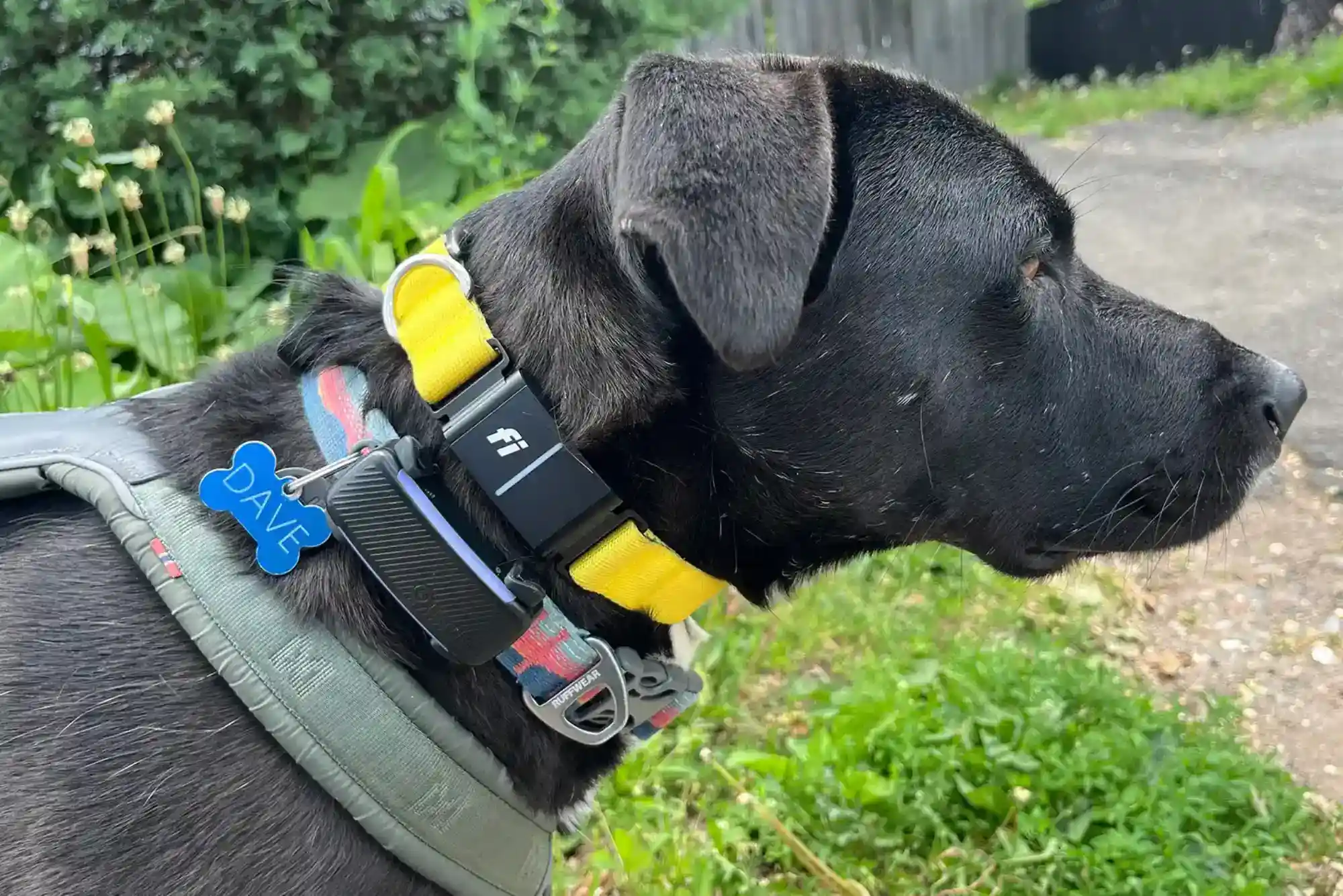
Popular current options include systems such as Tractive and Fi. Tractive, for example, is positioned as a cellular GPS tracker with live tracking and virtual-fence features, while Fi combines GPS with LTE connectivity and smart-collar functions.
The main limitation is simple: cellular coverage matters. If your dog disappears somewhere with no compatible mobile service, a standard cellular tracker may not be able to send fresh location information until connectivity returns.
Bluetooth Trackers
Bluetooth tags are often confused with GPS trackers, but they are fundamentally different.
An Apple AirTag, for example, does not continuously transmit its GPS coordinates to your phone. Instead, it communicates with nearby Apple devices through the Find My network. In a busy city, this can be surprisingly useful because many smartphones may pass near the missing dog.
The weakness becomes obvious in remote locations. If your dog runs into an isolated forest where there are few compatible phones nearby, there may be no new location report.
For that reason, Bluetooth devices are best considered an additional recovery tool rather than a replacement for dedicated GPS dog trackers for traveling.
Radio-Based Tracking
Radio tracking is especially useful for hunting, hiking, farming, and other off-grid situations.
Systems such as Garmin’s Alpha platform can communicate between a collar and a dedicated handheld receiver without depending on a cellular tower. This makes them fundamentally different from app-based cellular trackers.
The trade-off is equipment. Instead of simply attaching a tracker and using your existing smartphone, you generally need compatible handheld hardware. Range also depends on terrain, obstacles, equipment, and environmental conditions.
For serious backcountry travel, however, this approach can be much more dependable than a cellular tracker that has entered a dead zone.
Satellite Tracking
Satellite communication is another option for remote travel. It is particularly interesting for owners who spend time far beyond reliable cellular coverage.
Satellite-enabled pet tracking remains a more specialized category than conventional cellular GPS tracking. Availability, service plans, satellite communication capability, and geographic coverage vary considerably between products.
The key advantage is that satellite communication can potentially bridge the connectivity gap when traditional mobile networks are unavailable. Owners should carefully verify exactly what a product’s satellite feature does rather than assuming every device marketed as “satellite” provides continuous live tracking.
Best GPS Dog Trackers for Traveling on Road Trips
For ordinary road trips, cellular trackers are usually the most practical choice.
Road travel typically passes through towns, cities, suburbs, and highways where cellular networks are available. A cellular tracker can therefore provide live location information without requiring you to carry a specialized receiver.
A device such as Tractive is attractive for travelers who want a tracker that attaches to an existing collar and can provide location information through a smartphone app. Current comparisons also identify Tractive as a strong choice for international travel because coverage and roaming support are important considerations when crossing borders.
Fi is another option for owners who prefer an integrated smart-collar approach. Its longer battery-focused design can be useful for owners who dislike frequent charging, although travelers should always confirm service availability for the specific destination before leaving.
For road trips, the best GPS dog trackers for traveling should offer reliable escape alerts, reasonable battery life, comfortable attachment, and coverage along your actual route.
Best GPS Dog Trackers for Traveling Internationally
International travel adds another layer of complexity.
A tracker that works perfectly at home may have different coverage, roaming, activation, or subscription conditions in another country. Never assume that a cellular tracker automatically provides identical service everywhere.
Before traveling internationally, check the manufacturer’s supported countries and network requirements. This is especially important if you are crossing multiple borders during one trip.
Tractive is frequently compared favorably for international travel because its service is designed around broad cellular coverage rather than being tied to a single local network. Still, owners should verify current coverage and subscription conditions before departure because network availability can change.
Bluetooth tags can also be useful internationally because they do not require you to purchase a separate cellular subscription. However, their dependence on nearby compatible devices makes them less predictable in rural destinations.
For international trips, using a dedicated cellular tracker alongside a Bluetooth tag can provide useful redundancy.
Best GPS Dog Trackers for Traveling Off the Grid
Camping and wilderness trips change the buying decision completely.
If your destination has poor or nonexistent cellular service, don’t automatically choose a cellular tracker simply because it says “GPS” on the box. Remember that GPS determines position; cellular connectivity is what normally sends that position to your smartphone.
A radio-based system can be more appropriate when you are hiking with your dog in areas without mobile coverage. Garmin’s dedicated tracking systems are designed around communication between the collar and handheld device, allowing tracking without depending on cell towers.
Satellite-based options may also be worth investigating for extremely remote trips, but carefully examine their actual communication capabilities and service limitations.
For wilderness travel, the best GPS dog trackers for traveling are the ones that match the communication infrastructure available at your destination.
What to Look for Before Buying
Choosing among GPS dog trackers for traveling requires more than comparing prices.
Coverage
Coverage should be your first consideration. Look at the places where your dog will actually travel rather than simply choosing a tracker with the largest advertised range.
For cellular devices, check supported networks and countries. For radio systems, consider terrain and expected distance. For Bluetooth tags, think about how many compatible devices are likely to be nearby.
Battery Life
Battery life becomes particularly important during travel.
A tracker that lasts several days may be perfectly adequate for a weekend trip if you remember to charge it. For longer adventures, a device with significantly longer battery life can reduce the chance of the tracker dying when you need it.
Cold temperatures, frequent live tracking, weak cellular signals, and high activity can also affect real-world battery performance.
Size and Comfort
A tracker should not interfere with your dog’s movement.
Small dogs may find a large tracker uncomfortable, while larger dogs may have no problem carrying a heavier unit. Check the manufacturer’s weight recommendations and make sure the attachment is secure.
Water Resistance
Travel can expose a dog to rain, mud, swimming pools, lakes, and unexpected puddles.
A water-resistant or waterproof design is therefore much more practical than a delicate device that needs to stay completely dry. Always check the manufacturer’s specific water-resistance rating instead of assuming that every tracker can safely be submerged.
Subscription Costs
The purchase price is only part of the expense.
Many cellular trackers require a recurring subscription because the company must provide mobile connectivity and maintain the tracking service. Compare the long-term cost rather than judging devices solely by their initial price.
Bluetooth tags generally avoid this type of cellular subscription, but they also provide a very different level of tracking capability.
Are GPS Dog Trackers Worth It for Travel?
For many dog owners, yes.
The value becomes particularly obvious when traveling somewhere unfamiliar. A tracker cannot prevent every escape, but it can reduce the uncertainty that follows when a dog disappears.
That said, a tracker should never replace basic safety practices. Keep identification tags updated, use a secure leash, check hotel doors and gates, and supervise dogs around unfamiliar environments.
Think of GPS dog trackers for traveling as a backup safety system rather than a guarantee. The best tracker is one that remains charged, fits securely, has appropriate coverage, and matches the environment where your dog will be.
Cellular vs. Bluetooth vs. Satellite: Which Is Best?
There is no universal winner.
Cellular tracking is generally the easiest option for everyday travel because it combines GPS positioning with smartphone connectivity. It is especially suitable for cities, road trips, vacations, and destinations with dependable mobile coverage.
Bluetooth is inexpensive and convenient, making it useful as a secondary recovery device. Its major weakness is that it cannot provide the same dependable live tracking experience as a dedicated cellular GPS tracker.
Radio tracking is particularly valuable for serious outdoor users who regularly leave cellular coverage. It requires additional hardware but can provide direct communication between the dog’s collar and the owner’s handheld.
Satellite technology is most interesting for extremely remote adventures. As this category develops, owners should focus on actual communication capabilities rather than marketing terminology.
Ultimately, the best GPS dog trackers for traveling are determined by your destination, your dog’s behavior, your preferred tracking method, and how much ongoing cost you are comfortable with.
How to Prepare Your Dog Tracker Before a Trip
Don’t wait until the morning of your trip to test the tracker.
Charge the device completely and confirm that it communicates correctly with your phone or handheld receiver. Test the live-location function outdoors and verify that escape or safe-zone alerts work as expected.
If you are traveling internationally, check the destination’s network compatibility and service availability. It is also wise to update the tracker and smartphone application before leaving.
Create any necessary safe zones around your hotel, vacation rental, campsite, or relative’s home. Once you arrive, review those zones because the surroundings may be completely different from your normal setup.
Most importantly, make sure your dog has worn the tracker before the trip. A device that looks comfortable in your hand may behave differently when attached to a moving collar.
Choosing the Right GPS Dog Tracker for Traveling
The best GPS dog trackers for traveling are not necessarily the most expensive or feature-packed devices. The right choice depends on where you are going and how your dog spends time outdoors.
For road trips, cities, and destinations with reliable cellular service, a cellular GPS tracker is usually the most convenient solution. For urban travelers looking for an inexpensive backup, Bluetooth tags can provide another layer of protection. For serious wilderness adventures, radio-based tracking deserves strong consideration, while satellite technology may become increasingly useful for remote travel.
Before your next trip, check coverage, battery life, subscription requirements, size, water resistance, and communication technology. Most importantly, test the tracker before you need it.
FAQs
Do GPS dog trackers work without cell service?
Some do, but it depends on the communication technology. A standard cellular GPS tracker can determine its position using satellites but usually needs cellular connectivity to send that position to your smartphone. Radio-based systems can communicate directly with a handheld receiver without cellular service. Satellite-enabled products use a separate communication method.
Can I use an AirTag instead of a GPS tracker for my dog?
You can attach an AirTag to a dog’s collar, but it should not be treated as an equivalent replacement for a dedicated GPS tracker. AirTag depends on nearby Apple devices to report its location and does not provide continuous GPS tracking. It can be a useful backup, particularly in populated areas, but it is less dependable in remote environments.
What is the best GPS tracker for a dog that travels internationally?
A cellular tracker with confirmed coverage in your destination countries is generally the most practical choice. Tractive is one option frequently considered for international travel because of its broad coverage approach. Always verify current supported countries and subscription terms before departure.
What is the best dog tracker for hiking without cell service?
A radio-based GPS tracking system can be a stronger choice than a cellular tracker for hiking in areas without mobile coverage. Systems designed around a collar and dedicated handheld receiver can communicate directly without relying on a cell tower.
How far can a GPS dog tracker work?
There is no single answer because the communication technology determines the effective range. Cellular trackers can work over very large distances wherever supported cellular coverage exists. Bluetooth devices depend on nearby devices. Radio systems have a defined transmission range affected by terrain and line of sight.
Do GPS dog trackers need a monthly fee?
Many cellular GPS trackers require a subscription because they use cellular networks and an associated tracking service. Bluetooth item trackers generally do not require a monthly cellular subscription. Radio systems can avoid recurring cellular fees but may require more expensive dedicated hardware.